All the living things in an area and the way they affect each other and the environment. Everything that exists in a particular environment An ecosystem includes living things such as plants and animals and things that are not living such as rocks soil sunlight and water.
 Ecosystems For Kids Youtube
Did you know every nook and cranny of the world could be its own system.
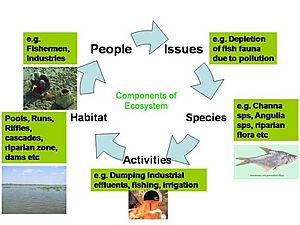
Ecosystem definition for kids. An ecosystem is made up of all of the communities and nonliving materials in an area. Read on to explore the structure components types and functions of the ecosystem in the ecosystem notes provided below. Living things interact with each other and also with non-living things like soil water and air.
An ecosystem is a geographic area where plant s animal s and other organism s as well as weather and landscape work together to form a bubble of life. This includes all of the plants animals and other living things that make up the communities of life in an area. Animals rely on plants as well as other animals for energy.
The members of a forest community rely on one another for survival. When ecosystems are damaged by man then some living organisms may not be able to survive. The term Ecosystem was first coined by AGTansley an English botanist in 1935.
Ecosystems come in different sizes. An ecosystem is made up of all of the living and nonliving things in an area. Saltwater and freshwater ecosystems exist in oceans lakes rivers and wetlands.
Biotic factor s include plants animals and other organisms. Living beings are also known as biotic while the inert as abioticExamples of living micro-organisms fungi plants and animals including human beings. The ecosystems are composed of living and non-living or inert living in a particular area.
In other words an ecosystem is a chain of interaction between organisms and their environment. Scientists sometimes describe this dependence using a food chain or a food web. An ecosystem is all the plants and animals that live in a particular area together with the complex relationship that exists between them and their environment.
Biomes and Ecosystems Desert Grasslands Savanna Tundra. The living things within an ecosystem are organisms like plants animals trees and insects that. The complex of a community of organisms and its environment functioning as an ecological unit That influx of fresh water alters the oceans salinity near the seafloor a factor that influences the makeup of the ecosystems in those places.
An ecosystem is a group of living and non-living things that depend on each other to survive. Ecosystem Definition for Kids Ecosystems are any area where living creatures such as plants and animals interact with non-living things like soil water temperature and air. DEFINITION OF ECOSYSTEMS An ecosystem is a community of interacting organisms and their environment.
Well watch this video to find out what. Sid Perkins Global warming if it proceeds as many scientists predict threatens. An ecosystem is an area where living organisms interact in a specific way with the local environment to survive.
A biome is a large group of similar ecosystems like the desert savanna and rainforest. Communities that live and interact with each other as well as with non-living things. An ecosystem can be as big as the entire planet or as little as the tiny bacteria you cant see that live on your skin.
A swamp a prairie an ocean and a forest are examples of. Iːkoʊsɪstəm US ekə- Word forms. A system or a group of interconnected elements formed by the interaction of a community of organisms with their environment.
Ecosystems on land can be found in forests grasslands tundra and deserts. It is here in the ecosystem that the communities depend on things like water sun and temperature. In an ecosystem plants and animals all rely on each other to live.
Ecosystems often contain many living things and can be as small as your backyard or as large as the ocean. Aquatic ecosystems differ radically from their terrestrial counterparts. An ecosystem also includes nonliving materialsfor example water rocks soil and sand.
Ecosystems contain biotic or living parts as well as abiotic factors or nonliving parts. Do you know what is an Ecosystem.
Communities of organisms that are dependent on each other and on their environment live in aquatic ecosystems. An aquatic ecosystem is an ecosystem that exists in water.
 Aquatic Ecosystem In Hindi Hindi Environment And Ecology Upsc Unacademy
The living beings include animals fishes snails reptiles plants and microbial flora in the sea and oceans.

What is aquatic ecosystem. In a pond eco-system the primary consumers are the tadpole larvae of frog fish and other aquatic animals which consume green plants or algae as their food herbivorous. With an aquatic ecosystem the environment is a watery one. They are divided into two main groups.
Freshwater ecosystems are found in water containing low concentrations of salts from ponds to estuaries. The two main types of aquatic ecosystems are marine ecosystems and freshwater ecosystems. Types of Aquatic Ecosystem.
So we can say that an aquatic ecosystem is a community of organisms that live together interact and to an extent depend on each other in a water based environment. These herbivorous aquatic animals become the food of secondary consumers. The opposite will be terrestrial ecosystems which are all ecosystems that exist on land.
Aquatic ecosystems feature various types of organisms including. They play a vital role in the nature of water its cycles as well as the organic content present in it both from natural and sedimentary sources soils. The aquatic system consists of more than 70 of the earth.
This waterbody can include marine and freshwater bodies. These living creatures whose food shelter reproduction and other essential activities depend in a water-based environment are known as aquatic organisms. Aquatic ecosystems comprise the largest portion of the biosphere and include both freshwater and marine ecosystems.
Furthermore ecosystems function as an ecological unit and therefore can be defined at a variety of scales. An Aquatic ecosystem is a habitat comprising of living beings residing within a water body. An ecosystem is a community of organisms that live and interact within a particular environment.
Marine ecosystems are found in the saltwater of seas and oceans. A scientist who studies inland water ecosystems limnology is called a limnologist. Aquatic ecosystems connect people land and wildlife through water.
Aquatic Ecosystems in simple terms is an ecosystem type that depends on water both marine and freshwater most or part of the time. An aquatic ecosystem is all that ecosystem that develops in a body of water of diverse size and nature which includes seas lakes rivers swamps streams lagoons and coasts. Aquatic ecosystems are critical components of the global environment.
The aquatic ecosystem provides the habitat for various animals plants and microbes that are water dependents. An ecosystem is defined as a distinct community of organisms including plants animals and so on that exists in a particular environment. The notable aquatic ecosystems are ponds lakes rivers bogs canals streams wetlands swamp estuaries and ocean etc.
Types of Aquatic Ecosystem There are different types of aquatic ecosystems. The examples of secondary consumers are frogs fishes snakes crabs etc. They cover only a small portion of earth nearly 08 per cent.
Different types of aquatic ecosystems are as follows. In an aquatic ecosystem that environment is water and all the systems plants and animals live either in or on that water. Communities of organisms that are dependent on each other and on their environment live in aquatic ecosystems.
The aquatic ecosystem is the habitat for water-dependent living species including animals plants and microbes. The aquatic ecosystem definition states it is a water-based environment wherein living organisms interact with both physical and chemical features of the environment. AQUATIC ECOSYTEM An aquatic ecosystem is an ecosystem in a body of water.
In addition to being essential contributors to biodiversity and ecological productivity they also provide a variety of services for human populations including water for drinking and irrigation recreational opportunities and habitat for economically important fisheries. Water-based ecosystems can be put into two main groups namely Freshwater Ecosystems and Marine Ecosystems. Communities of plants and animals living in water are known as aquatic ecosystems.
A stream is an example of a freshwater ecosystem. 1 Minute Read Wetlands rivers lakes and coastal estuaries are all aquatic ecosystemscritical elements of Earths dynamic. Plants and animals interact with the biotic and abiotic factors of aquatic ecosystems.
Definition of Aquatic Ecosystem First of all an ecosystem is a community of living organisms and their physical and chemical environment linked with the help of flows of energy and nutrients. An aquatic ecosystem is an ecosystem in a body of water. An aquatic ecosystem is an ecosystem that is water based.
The sources of organic matter in these systems can be both internal autochthonous and external allochthonous. An aquatic ecosystem is a water-based environment. Aquatic ecosystems are categorized as the marine ecosystem and the freshwater ecosystem.
An ecosystem is a distinct community of organisms in a specific environment. The word aquatic comes from the Latin word for water.