Hyponatremia is the most common electrolyte disorder in lung cancer patients. In an analysis of nine consecutive clinical trials conducted jointly at four hospitals in Denmark and Sweden a serum sodium level.
 Hyponatremia In Cancer Patients Time For A New Approach Sciencedirect
Hyponatremia detected in in-hospital cancer patients is associated with a longer hospital length of stay and an increased.

Hyponatremia and lung cancer. Hyponatremia incidence in malignancy may be underestimated. Hyponatremia seems to be an independent predictor of inferior survival in lung cancer patients especially in patients with NSCLC. The hyponatremia observed in patients with cancer usually results from nonosmotic release of vasopressin with consequent hypo-osmolar hyponatremia.
Lung cancer is the leading cause of cancer-related death globally. Who analyzed a population of patients with lymphoma breast cancer colorectal cancer small cell and non-small cell lung cancer. Similar results were obtained by Castillo et al.
Nausea pain and baroreceptor release of vasopressin also known as antidiuretic hormone ADH are common causes of excess ADH release while ectopic production of ADH from tumors such as small cell lung cancer is relatively rare. This condition may be related to many causes including incidental medications concurrent diseases and side effects of antineoplastic treatments or the disease itself. Hyponatremia was marginally associated with shorter PFS HR 13 P 07 across cancer types.
Short-term hyponatremia correction was associated with better survival. This condition may be related to many causes including incidental medications concurrent diseases and side effects of antineoplastic treatments or the disease itself. The impact of hyponatremia on the cost of care for cancer patients is significant.
Electrolyte imbalance has been associated with poor survival in lung cancer patients 2 - 4. Hyponatremia was negatively associated with OS in all types of tumor but the highest HRs were found in lymphoma HR 45 P 001 and in breast cancer HR 37 P 01. Small cell lung cancer SCLC occurs in 1520 of lung cancer.
Hyponatremia and hypercalcemia are most commonly associated with lung cancer among other cancer types 5 - 7. Hyponatremia defined as a plasma sodium concentration PNa. Hyponatremia in Lung Cancer Hyponatremia ielow blood sodium levels is the most common electrolyte imbalance disorder found in lung cancer patients.
Hyponatremia is a common electrolyte disorder in lung cancer patients especially in patients with small-cell lung cancer SCLC. Being usually asymptomatic hyponatremia may cause symptoms like nausea fatigue disorientation headache muscle cramps or even seizures particularly if severe and rapid decrease of serum sodium levels occurs. However data have been conflicting.
The length of hospital stay nearly doubles in patients with hyponatremia compared to those for cancer patients who are normonatremic and this difference may perhaps be attributed to the slow or unpredictable response to correction in patients with cancer. This condition can be related to a plethora. Hyponatremia may also impact response to cancer therapy.
Hyponatremia can be a potential negative prognostic factor in patients diagnosed with solid tumors or hematological malignancies such as lung cancer breast cancer lymphoma and colorectal cancer. Hyponatremia is reported approximately 15 of SCLC. Highly malignant small cell lung cancer SCLC tumors are often associated with paracrine and paraneoplastic syndromes.
Physicians caring for patients with breast cancer without lung or brain involvement diagnosed with SIADH without an obvious etiology should consider obtaining lung and brain imaging to rule out undiagnosed metastatic spread. Hyponatremia is the most common electrolyte disorder in lung cancer patients. The aim of this retrospective study is to investigate the association between hyponatremia and prognosis of SCLC.
In cirrhosis hyponatremia is associated with a higher morbidity and mortality. In a study of nonsmall cell lung cancer patients treated with platinum-based regimens there was a differential response to. Ten to 15 of patients with SCLC develop hyponatremia plasma sodium 125 mmolL a problem that has befuddled clinicians since its recognition in 1957.
Hyponatremia in lung cancer is most commonly related to the syndrome of inappropriate anti-diuretic hormone secretion SIADH 4 8 - 11. SIADH is associated with most malignancy types. Decompensated cirrhosis in liver cancer patients represents an additional complicating factor.
It has been proposed as a prognostic indicator of higher mortality. However the prevalence is much more pronounced in cancer patients affecting nearly half of patients. Hyponatremia is a frequent electrolyte abnormality in patients with small cell lung cancer SCLC.
Among cancer patients hyponatremia occurs most frequently with small cell lung cancer SCLC. The incidence of hyponatremia is higher than previously reported in lung cancer is high in lymphoma BC and CRC and is a negative prognostic indicator for survival. The incidence of pretreatment hyponatremia is high in patients with SCLC as well as with NSCLC.
While smoking isnt the only cause of lung cancer you are at much greater risk of lung cancer if you are a current or past smoker. Scientists have known that smoking causes cancer since at least the 1940s when epidemiological studies showed a clear link between smoking and lung cancer.
 Who Smoking Causes Lung Cancer
Many chemicals that cause cancer are in.
Do cigarettes cause lung cancer. You know by now that cigarette smoking is the No. When you inhale cigarette smoke which is full of cancer-causing substances carcinogens changes in the lung tissue begin almost immediately. Moreover daily cigar smokers particularly those who inhale are at increased risk for developing heart disease and other types of lung disease.
If you smoke more than 25 cigarettes a day you are 25 times more likely to get lung cancer than a non-smoker. Just a few cigarettes a day -- or low levels of secondhand smoke -- can hurt your. Smoking cigarettes is the single biggest risk factor for lung cancer.
Today its known that tobacco smoke contains at least 70 cancer-causing chemicals. The amount of Benzoapyrene in cigarettes is approximately to 85 to 176 mg. Smoking causes around 7 in 10 lung cancer cases in the UK which is also the most common cause of cancer death.
It is usually found in gasoline crude oil and petrochemicals. My friend is a smoker. Some carcinogens do not directly cause cancer but can lead to cancer.
It may also cause cancer of the pancreas. Benzene is classified as hydrocarbon because it is only contain of carbon six carbon joined with hydrogen. At first your body may be able to repair this damage.
E-cigarettes sometimes called vapes run on batteries and heat up nicotine flavorings and other chemicals. In addition to about 85 of lung cancers cigarette smoking is responsible for a large fraction of bladder head and neck and esophageal cancers. This is because tobacco smoke is inhaled and the lungs then transport the chemicals in the smoke to the bloodstream along with oxygen where it is distributed to the rest of the body.
About 85 percent of lung cancer diagnoses are in current and former smokers says Dr. List of Organic Chemicals. 1 risk factor for lung cancer.
When you smoke the cancer-causing substances in cigarettes called carcinogens begin to change the tissue in your lungs almost immediately. Doctors believe smoking causes lung cancer by damaging the cells that line the lungs. There are many chemicals in cigarettes that are known to cause cancer including formaldehyde arsenic and benzene.
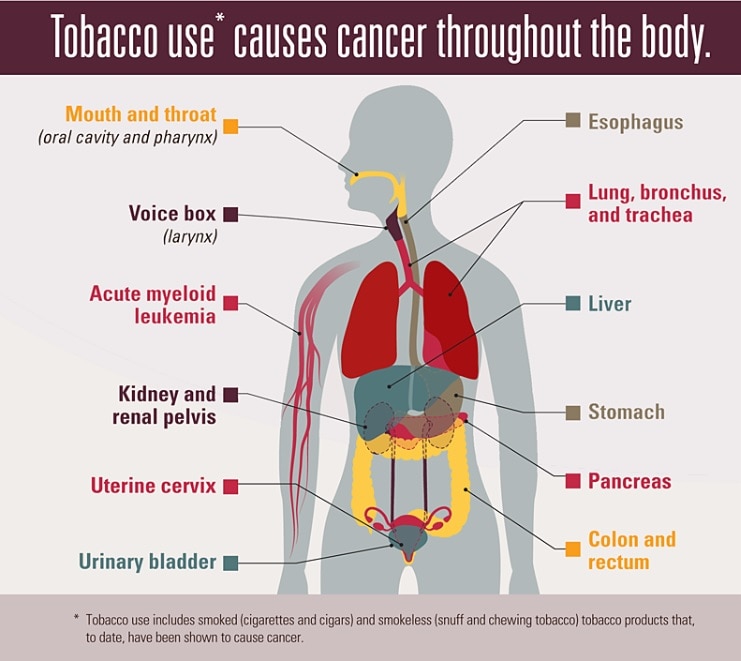
Smoking not only causes cancer in the lungs but can also cause cancer in other organs such as the bladder. The long-term exposure to these chemicals is thought to generate the cell mutations that lead to cancer. Another animal study from 2018 concluded that smoke from.
Both claim there is no firm proof that cigarettes cause lung cancer. Smoking causes cancers of the lung esophagus larynx voice box mouth throat kidney bladder pancreas stomach and cervix as well as acute myeloid leukemia 6. This article makes a similar claim -- in particular that smoking cigarettes is not proven to cause cancer but that it is linked to an increased risk of dying from lung cancer.
They turn them into a vapor you can breathe in. While someone who smokes one pack of cigarettes per day has a risk for the development of. Its responsible for more than 70 of cases.
Smoking is far and away the leading cause of lung cancer even for nonsmokers who get it from secondhand smoke. His dad is a doctor. Pipe and cigar smoking can also cause lung cancer although the risk is not as high as with cigarettes.
Some carcinogens cause cancer if you have long-term high levels of exposure. Yes a US white male USWM cigarette smoker has an 8 lifetime chance of dying from lung cancer but the. Cigar smoking causes cancer of the oral cavity larynx esophagus and lung.
Tobacco smoke contains more than 60 different toxic substances which are known to be carcinogenic cancer-producing. You may also read. How your body reacts to this level of exposure the length the time and the intensity of the exposure combined with your genetic makeup will determine the risk of developing cancer.
Regardless of their age smokers can substantially reduce their risk of disease including cancer by quitting. Researchers found that exposure to e-cigarette vapor led to DNA- and gene-level changes that could increase the risk of lung cancer. It causes other cancers including mouth pharynx upper throat nose and sinuses larynx voice box oesophagus food pipe liver pancreas stomach kidney bowel ovary bladder cervix and some types of leukaemia.
That cigarettes cause cancer is no secret. These not only contribute to the development of lung cancer but other cancers as well including cancers of the mouth throat stomach colon rectum kidney bladder cervix and blood most commonly acute myeloid leukemia.